Archive

December 27, 2025

Browsing

President Donald Trump said he will call the final shots on a peace deal to end the conflict between Russia and Ukraine, with Ukrainian President Volodymyr Zelenskyy preparing to unveil a new peace plan when the two meet Sunday. 

‘He doesn’t have anything until I approve it,’ Trump told Politico Friday. ‘So we’ll see what he’s got.’

Zelenskyy told reporters Friday he will meet with Trump Sunday in Florida and will share a 20-point peace proposal for the president to review. 

Additionally, Zelenskyy said the meeting will likely focus on security guarantees for Ukraine, adding it was unclear if ‘territorial issues will be discussed.’

‘The 20-point plan that we worked on is 90% ready. Our task (is) to make sure that everything is 100% ready. It is not easy, and no one says that it will be 100% right away, but nevertheless we must bring the desired result closer with each such meeting, each such conversation,’ Zelenskyy told reporters Friday.

The White House did not respond to a request for comment from Fox News Digital to confirm the meeting. 

Trump voiced optimism about the meeting with Zelenskyy and future conversations with Putin. 

‘I think it’s going to go good with him. I think it’s going to go good with [Vladimir] Putin,’ Trump told Politico. Trump also said that he expects to speak with Putin ‘soon.’

Trump said in November he would not meet with Zelenskyy again — or Putin — unless a deal to end the war was in its final stages. 

Zelenskyy has indicated progress is being made and touted that he had a ‘a very good conversation’ with Jared Kushner and U.S. special envoy Steve Witkoff Thursday. Specifically, Zelenskyy said, talks focused on ending the war and efforts to ensure lasting peace in the region.

Trump has met with Zelenskyy multiple times since taking office in January, including in February when Zelenskyy sparred openly with Trump and Vance in the Oval Office over engaging in diplomacy with Russia to end the conflict. Additionally, Trump met with Putin in Alaska in August. 

Fox News’ Rachel Wolf contributed to this report. 

This post appeared first on FOX NEWS
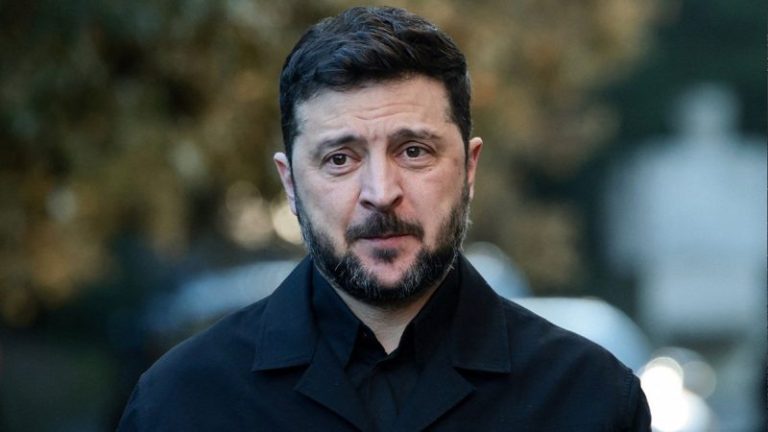
The president of the Kennedy Center on Friday sharply criticized longtime jazz musician Chuck Redd for canceling his Christmas Eve performance days after the White House announced that President Donald Trump’s name would be added to the iconic performing arts institution in Washington, D.C.

Kennedy Center president Richard Grenell said Redd’s decision financially harmed the nonprofit institution, and he would seek $1 million in damages, accusing him of carrying out a ‘political stunt.’

‘Your decision to withdraw at the last moment — explicitly in response to the Center’s recent renaming, which honors President Trump’s extraordinary efforts to save this national treasure — is classic intolerance and very costly to a non-profit Arts institution,’ Grenell wrote in a letter to Redd, obtained by Fox News Digital.

Fox News Digital could not immediately reach Redd for comment.

Redd, who has hosted holiday Jazz Jams at the venue since 2006, abruptly canceled his Christmas Eve performance after Trump’s name was added to the facility.

‘When I saw the name change on the Kennedy Center website and then hours later on the building, I chose to cancel our concert,’ Redd told The Associated Press on Wednesday.

On Dec. 18, the Kennedy Center’s board voted unanimously to rename the institution the ‘Trump-Kennedy Center.’

The update was immediately criticized by members of the Kennedy family who argued it undermined the legacy of President John F. Kennedy.

Maria Shriver, Kennedy’s niece, reacted harshly to the decision, saying it was ‘beyond comprehension.’

Several artists have canceled performances at the Kennedy Center since Trump’s return to office, including Lin-Manuel Miranda, who called off a production of ‘Hamilton.’

Kennedy Center vice president of public relations Roma Daravi told Fox News Digital Friday that Redd was politicizing art by calling off his performance.

‘Any artist canceling their show at the Trump Kennedy Center over political differences isn’t courageous or principled—they are selfish, intolerant, and have failed to meet the basic duty of a public artist: to perform for all people,’ she said in a statement.

Daravi stated that art is ‘a shared cultural experience meant to unite, not exclude,’ calling the venue ‘a true bipartisan institution that welcomes artists and patrons from all backgrounds.’

She added that ‘great art transcends politics,’ and that ‘America’s cultural center remains committed to presenting popular programming that inspires and resonates with all audiences.’

Last week, workers added President Trump’s name to the building’s exterior, and the website header was updated to read, ‘The Trump Kennedy Center.’

The Associated Press contributed to this report.

This post appeared first on FOX NEWS
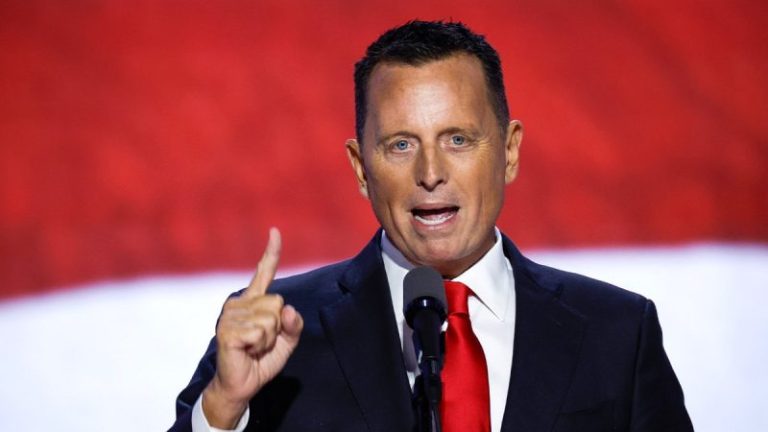
As a writer, there are times when I read something and think, ‘Wow, that’s good, this cat has chops.’ Very rarely do I read something that’s new, that I didn’t know was possible. Ben Sasse, he just wrote one of those.

The former Republican senator from Nebraska was informing the nation that he has stage four cancer and is going to die soon.

‘Advanced pancreatic is nasty stuff; it’s a death sentence,’ he write. ‘But I already had a death sentence before last week too — we all do.’

It may seem trivial, or even cruel to ponder Sasse’s written words when we know the pain he and his family must feel, but it is not trivial to me, and never has been in the history of man.

Shakespeare called death the undiscovered country, but Sasse preferred to focus on what we know, writing, ‘To be clear, optimism is great, and it’s absolutely necessary, but it’s insufficient. It’s not the kinda thing that holds up when you tell your daughters you’re not going to walk them down the aisle. Nor telling your mom and pops they’re gonna bury their son.’

‘Kinda,’ as a writer, this casual usage that my editors often change when I employ it is the embodiment of what Sasse has wrought here. His words make me think that beauty always portends tragedy, but that’s okay. To invoke a New Yorkism, it is what it is.

Sasse, who went from the Senate to serve as president of University of Florida until last year, goes on to say, ‘A well-lived life demands more reality — stiffer stuff. That’s why, during Advent, even while still walking in darkness, we shout our hope — often properly with a gravelly voice soldiering through tears’

Aside from a few modern references, Sasse’s letter to our nation would have been understood perfectly 2,500 years ago in Athens, where such writing of the examination of the human condition was born.

Sasse tells us that, ‘Remembering Isaiah’s prophecies of what’s to come doesn’t dull the pain of current sufferings. But it does put it in eternity’s perspective: 

‘When we’ve been there 10,000 years…We’ve no less days to sing God’s praise.’

Maybe what stands out the most in this incredible piece of writing is that it is not performative at all, in an age in which everything is. In the law, a dying declaration holds special weight. In Sasse’s pen, it holds our hearts.

Much of our languages’ great work involves death, Dylan Thomas imploring his father in poetry: ‘Do not go gentle into that good night.

Rage, rage against the dying of the light.

As I read his profound letter to us, I couldn’t help but see the image of Sasse in his running clothes, stooped on a stone wall at the capitol, chopping it up with Schumer and McCain. Just a regular guy, one of us.

Reading his words about his own mortality, I see now he is much more than that. I spend almost the whole time I’m awake reading, when I’m not writing. At 50, little surprises me. This did.

My mother died of damnable cancer when I was 24, her final request of me was to write and deliver her eulogy, and I’ll be honest the request felt too hard. But when she died, I had a job to do, and for two days I did nothing but write, it was her last gift, she knew me, and she got me through it.

I’m so grateful for Sasse’s words, and that at a time when everything is so ugly, he took the occasion of personal horror to buck us up. His great-great-grandchildren will know of it and feel rightful pride.

God bless Ben Sasse and his family, and may his profound and beautiful words echo down the centuries as the epitome of grace in a falling world.

As a writer, I want to say, thank you senator, I know right now it must seem completely insignificant, but there is a scribe in West Virginia today who will be forever changed by those words, and I’m grateful for it.

This post appeared first on FOX NEWS
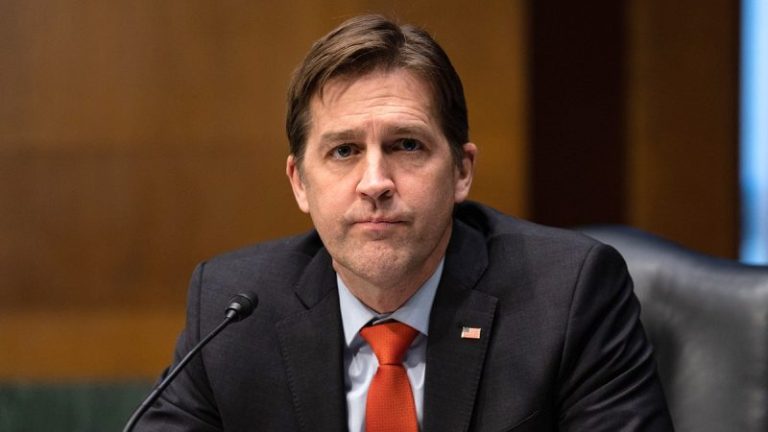
A fresh Russian attack against Kyiv involving hundreds of drones and dozens of missiles is putting the ‘true attitude of Putin and his inner circle’ on display, Ukrainian President Volodymyr Zelenskyy said Saturday, as he prepared to meet with President Donald Trump. 

The overnight blitz in Ukraine’s capital left at least one person dead and 27 injured, local authorities told the Associated Press. It unfolded as Zelenskyy is set to meet with Trump in Florida on Sunday, where he said he will share a 20-point peace proposal to end the conflict with Russia. 

‘Another Russian attack is still ongoing: since last night, there have been almost 500 drones – a large number of ‘shaheds’ – as well as 40 missiles, including Kinzhals. The primary target is Kyiv – energy facilities and civilian infrastructure,’ Zelenskyy wrote on X on Saturday morning. ‘Regrettably, there have been hits, and ordinary residential buildings have been damaged. Rescuers are searching for a person trapped under the rubble of one of them.’ 

‘There have been many questions over the past few days – so where is Russia’s response to the proposals to end the war offered by the United States and the world? Russian representatives engage in lengthy talks, but in reality, Kinzhals and ‘shaheds’ speak for them. This is the true attitude of Putin and his inner circle,’ Zelenskyy added. ‘They do not want to end the war and seek to use every opportunity to cause Ukraine even greater suffering and increase their pressure on others around the world.’

Zelenskyy also said Saturday that, ‘If Russia turns even the Christmas and New Year period into a time of destroyed homes and burned apartments, of ruined power plants, then this sick activity can only be responded to with truly strong steps.’ 

‘The United States has this capability. Europe has this capability. Many of our partners have this capability. The key is to use it,’ he declared. 

Trump, ahead of the meeting with Zelenskyy, has said he will call the final shots on a peace deal to end the conflict.

‘He doesn’t have anything until I approve it,’ Trump told Politico Friday. ‘So we’ll see what he’s got.’ 

The Russian Defense Ministry said Saturday that it carried out a ‘massive strike’ overnight, using ‘long-range precision-guided weapons from land, air, and sea, including Kinzhal hypersonic aeroballistic missiles’ and drones, on energy infrastructure facilities ‘used by the Ukrainian Armed Forces,’ as well as ‘Ukrainian military-industrial complex enterprises.’ 

The ministry said the strike came in response to Ukraine’s attacks on ‘civilian objects’ in Russia.

Earlier on Saturday, the ministry said its air defenses shot down seven Ukrainian drones over the Russian regions of Krasnodar and Adygeya overnight. 

Fox News Digital’s Diana Stancey and The Associated Press contributed to this report. 

This post appeared first on FOX NEWS
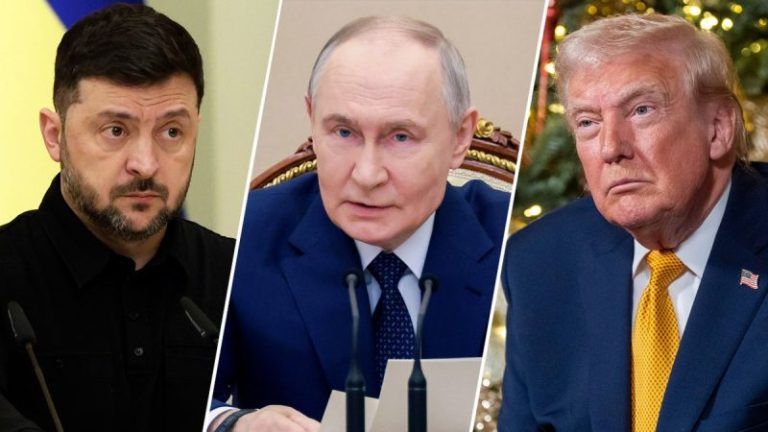
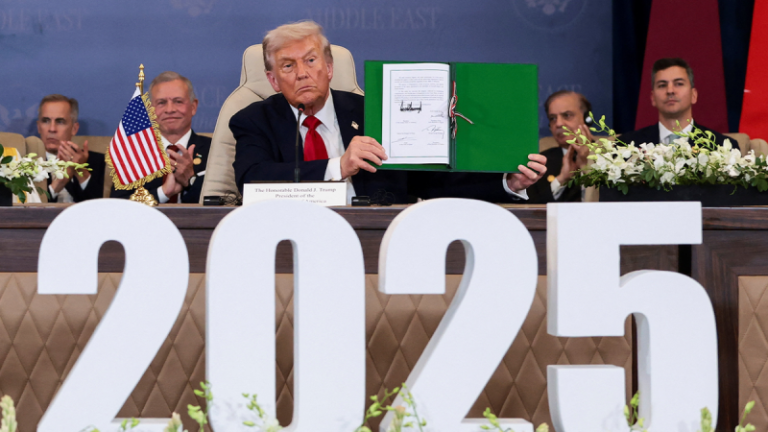
Donald Trump entered 2025 pledging to end wars and reorient U.S. foreign policy around what he repeatedly described as ‘peace through strength.’

Throughout the year, Trump has cast his diplomacy as peace-focused, telling reporters, ‘We think we have a way of getting peace,’ and publicly arguing that his record merited a Nobel Peace Prize. The U.S. State Department echoed that framing in its year-end summary of diplomatic efforts, highlighting initiatives it said aimed to ‘secure peace around the world.’

By the close of 2025, several conflicts saw impressive diplomatic progress, while others were still experiencing issues after years of hatred and violence.

Gaza (Israel–Hamas)

The most consequential diplomatic development of the year came in early October, when the Trump administration helped broker a ceasefire framework between Israel and Hamas. The agreement halted large-scale fighting after months of intense combat and enabled the release of all remaining hostages from Hamas’ Oct. 7 attack on Israel, except for the body of Ron Gvili that remains held captive by Hamas terrorists. 

The administration later cited the ceasefire as a central element of its 2025 diplomatic record. While the truce largely held through the end of the year, core issues including Gaza’s long-term governance, demilitarization and enforcement mechanisms remained unresolved, as well as rebuilding the enclave after the massive destruction and displacement. U.S. officials continued working with regional partners on next steps as fighting paused, as Israel’s Netanyahu is expected to meet with President Trump next week for talks on Gaza and other issues. 

Armenia–Azerbaijan

In August, Trump hosted the leaders of Armenia and Azerbaijan at the White House for a U.S.-brokered peace declaration aimed at addressing decades of conflict tied to Nagorno-Karabakh. The agreement focused on transit routes, economic cooperation and regional connectivity and was promoted by the administration as a historic step.

While the historic declaration was signed, implementation and deeper reconciliation is still ongoing.

Ukraine–Russia war

Ukraine remained the most ambitious and elusive peace target of Trump’s 2025 agenda. The year opened with Trump insisting the war could be ended through direct U.S. engagement and leverage over both Kyiv and Moscow. Diplomacy intensified in August, when Trump hosted Russian President Vladimir Putin in Alaska, a summit framed by the White House as a test of whether personal diplomacy could unlock a settlement.

In parallel, Ukrainian President Volodymyr Zelenskyy was received at the White House, where Trump reiterated U.S. support for Ukraine while signaling that any peace would require difficult compromises. U.S. officials explored security guarantees and economic incentives, while avoiding public commitments on borders or NATO membership.

By December, talks accelerated. Ukraine entered new rounds of U.S.-led negotiations, and Trump told reporters the sides were ‘getting close to something.’ On Christmas Zelenskyy said talks with U.S. officials had produced a 20-point plan and accompanying documents that include security guarantees involving Ukraine, the United States and European partners. He acknowledged the framework was not flawless but described it as a tangible step forward. Zelenskyy is reportedly readying a visit to meet with President Trump, possibly as soon as Sunday.

Bloomberg reported that Russia views the 20-point plan agreed to between Ukraine and the U.S. as only a starting point. According to a person close to the Kremlin, Moscow intends to seek key changes, including additional restrictions on Ukraine’s military, arguing that the proposal lacks provisions important to Russia and leaves many questions unanswered.

Democratic Republic of Congo–Rwanda

In early December, Trump hosted the signing of the Washington Accords for Peace and Prosperity between the Democratic Republic of Congo and Rwanda. The agreement reaffirmed commitments to end decades of conflict and expand economic cooperation through a regional integration framework.

By the end of the year, Reuters and the Associated Press reported that armed groups remained active in eastern Congo, underscoring the fragility of the accord, though both sides seemed to be invested in a long-term peace.

India–Pakistan

After a terrorist attack in Kashmir and retaliatory strikes raised fears of escalation, U.S. officials engaged in emergency diplomacy. Trump announced a ceasefire between the two nuclear-armed rivals, with a potentially catastrophic escalation between the two nuclear powers avoided.

Cambodia–Thailand border dispute

On the sidelines of an ASEAN summit, Trump helped mediate a ceasefire between Cambodia and Thailand following months of border clashes. 

Diplomatic efforts led by ASEAN and supported by external parties are ongoing, but fresh clashes and mutual recriminations between Thailand and Cambodia continue to challenge peace prospects and have led to large-scale displacement and civilian harm. Following the recent flare-ups, and with offers for mediation from Secretary of State Marco Rubio, a new ceasefire was agreed upon on Saturday to end weeks of fighting on the border.

Iran–Israel confrontation

Following U.S. and Israeli strikes on Iranian nuclear facilities, the Trump administration focused on containing escalation and reinforcing deterrence. No diplomatic agreement followed, but the confrontation did not expand into a broader regional war by year’s end.

Recently Israel warned that Iran might use its ballistic missile drills as a cover for a surprise attack. 

Sudan

Sudan remained one of the world’s deadliest conflicts. U.S. diplomacy has focused primarily on efforts to halt fighting and expand humanitarian access rather than brokering a comprehensive peace.

In December, Saudi Arabia and the United States presented Sudanese army chief Abdel Fattah al-Burhan with a three-point proposal aimed at ending the war, facilitating aid delivery and transferring power to civilians, according to Sudan Tribune.

Venezuela

As the year closed, Venezuela emerged as the United States’ clearest point of direct confrontation. The administration framed its posture as an extension of its broader ‘peace through strength’ doctrine, even as the risk of escalation lingered.

While the White House pursued de-escalation and negotiated arrangements elsewhere, its approach toward Nicolás Maduro relied almost entirely on pressure, not talks. Trump continued to cast Maduro as a criminal threat tied to drug trafficking, accusing him of rejecting the results of Venezuela’s last election and stealing the presidency.

With no diplomatic channel open, the U.S. maintained sweeping sanctions and stepped up efforts against cartel networks linked to the regime. There was no peace process in sight — but some opposition figures and U.S. allies argued that sustained pressure could still force political change in 2026, and ultimately hasten the end of Maduro’s rule.


This post appeared first on FOX NEWS